Skip to content | Skip to menu | Skip to search

CalArti

Essays on Photography

:: Next Page >>

07/19/08

Green Summer Fields

It’s been a wet summer, and the fields in west Michigan are green and verdant. Places that were dry grass two summers ago are completely submerged this year, and the populations of frogs and toads seem to be booming. Standing near the marsh now, I hear the “pliiiingggg” of bull frogs and the occasional chirps of other species. Wandering through the savannah, looking for dragonflies, I’ve stumbled into a few gray tree frogs and even a couple of cricket frogs.

The Dot-tailed Whitefaced Dragonflies are gone. I found a photo of one on the memory card when I dumped this weeks work, but realized it was a hold over from July 3. I believe that was the last time I saw one, and probably marks the end of their presence this year.

Dot Tailed Whiteface

The blue dashers remain out in force. They remind me of the Great Spangled Fritillaries a few years ago – they were just insanely abundant for one summer, after which their populations dropped back down to normal.

As the summer matures, the red dragonflies are coming out in numbers as well. So far I’ve seen only Whitefaced Meadowhaks. The distinctive white face on the fire engine red males make these an easy species to identify. But hopefully some ruby and cherry faced meadowhawks will be along soon.

Whitefaced Meadowhawk

The butterfly weed is also in bloom and with the were Edwards Hairstreaks, Coral hairstreaks, and even a few Karner Blues. More photos can be found in the image stream.

07/12/08

The Shady Spot

Where to go on a hot July afternoon? Find a shady spot, of course. That was my logic last Thursday, when I found myself back in a clearing in the Allegan Forest - off of a barricaded two track, off of some seasonal road, off of 122nd avenue, off of M89. It was a place I’ve never been to before – I need to find more spots like that.

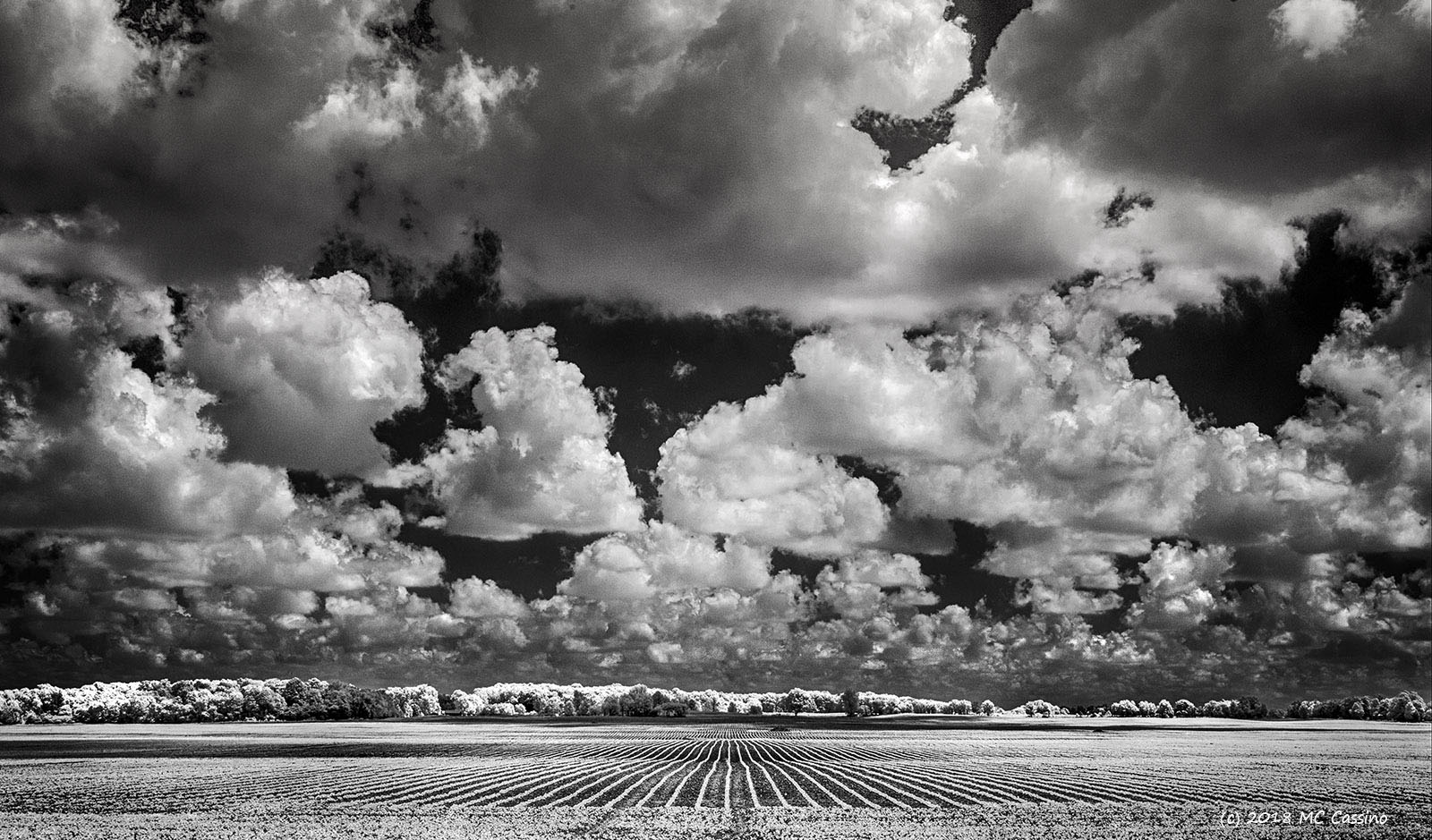
Infrared photo of a shady place.

You wouldn’t expect that I’d get tired of shooting dragonflies – it seems to take longer every season, but this week I finally lost the dragonfly vibe. Though the fields were teeming with blue dashers and more than a few skimmers of various sorts, I left the digital camera and the macro rig behind. I wandered back into the clearing with a trusty Pentax LX loaded with Rollei IR 400 film, a couple of zoom lenses, and an R72 filter.

I shot two rolls of the Rollei film – 72 frames, but with bracketing only about 20 different compositions. Digital has really spoiled me – I feel like I’ve wasted an afternoon if I don’t take 200 shots. That is one of the great perils of digital photography - you become your own army of monkeys, pounding at the shutter button. Accidental successes seem to be triumphs, but it’s hard to figure out how you got there and recreate the work. Not to mention that accidnets have no concept behind them.

Well - back to the fields and forest. I found a pearl in the sandy soil, often the case there.

This was my third session with the Rollei film. It was shot with the R72 filter, metered though the lens with the ISO set at 200 (thanks, Ray!) Film was developed in HC110, Dil H (1:66) at 20C for 24 minutes, with very low agitation (gentle agitation every 3 minutes for the first 12, then every 60 seconds.) I like it, but I don’t see it as a replacement for HIE. It’s much too slow with the R72 filter, and I really like using a plain red filter and being able to check and tweak the composition as I’m hitting the shutter button.

Rollei IR 400, with an R72 filter, is also a pretty high contrast film. Despite my attempt at using HC110 as a compensating developer, the film is a tough beast to tame with shadow areas virtually clear on the negative. But, when it comes to B&W shots, contrast is your friend. Not a friend I’ve really come to terms with, but working with this film has been a big boost in helping me understand and work with higher contrast mono shots.

07/05/08

Along the Wood Line

The whitetail deer saw me long before I saw her. She bolted across the intermittent marsh, splashing water up over her head as she ran off.

I’ve encountered a deer on each of the last four visits to the vernal marsh off 48th avenue in the Allegan Forest. Maybe it is the same one, maybe not. But it is usually near the edge of the marsh and usually storms across it, making quite a commotion.

Sorry, no pictures of the deer. My slack and sleeping senses have been too dull to capture the deer in flight. I have been sincerely surprised each time this event happens, until I realize that it’s just like a few days ago.

Anyhow, I go to this place to take pictures of insects… particularly dragonflies. In that respect, it did not disappoint over the last week.

Dot Tailed Whiteface Dragonfly

The Dot Tailed Whitefaces are still out in force. I am amazed that I had not seen this species before, but looking over my older images they don’t come up. Although tye are smaller than many of the dragonfly species prevalent now, these plain black insects are still around.

Whitefaced Meadowhawk Dragonfly

Red Meadowhawks are back and growing in numbers. They will rule the next few months. I used to say that when the red dragons appear, fall is in the air – but these last few years have shown me htat they can come out in early summer. I expect that they will stay around for a while.

Otherwise, the blue darners, twelve spotted skimmers, window skimmers, and spangled skimmers are still abundant. And, of course, the blue dashers are still ruling the roost, and in several of the field sI visited were the most prominent dragonfly.

The sandy fields in the Allegan Forest are surprisingly verdant and green – thanks to the crazy weather we’ve been having (which includes a lot of heavy storms.) Walking back to the car after shooting near the intermittent marsh, I startled a young doe that was bedded down and hiding in the tall green grass and vetch. It was quite a sight to see this little deer – no larger than a terrier – scramble off to the wood line.

More images are in the Image Stream.

06/28/08

The Planets!

Six months ago Maryellen Hains pulled together a diverse group of local artists and proposed a show themed around the number seven. After a bit of reflection, discussion, and some very tasty lunches at Hunan Gardens, the group settled on the concept of working with the seven planets of the ancients.

The show was based around the concept of two artist first working independently on their pieces, and then coming together to create a collaborative piece.

Weaver Gretchen Hugget and I drew the planet Jupiter. While I was fascinated by the mythological and astrological aspects of Jupiter, I found actual images of the planet to be much more compelling.

Imaginary Jupiter

And so I decided to create a photograph of the planet for my personal entry. A macro shot of algae floating on a mud puddle was the starting point – tweaking the color channels to turn green to blue resulted in a background that looked a lot like a starry sky. The denser part of the algae took on the form of a nebula, and the many air bubbles floating under the surface of the water took on the appearance of distant stars.

For the planet Jupiter itself, I took a bunch of photos of textures and colors and melded them together into a square tapestry. I more or less used things under the astrological rule of Jupiter to do this, drawing in the mythic and cultural aspects of the planet. After creating the square image I digitally transformed it into a sphere, and spent far too much time blending the layers and working on the shading and lighting effects.

The show opened this evening at the Carnegie Center, Three Rivers, Michigan. It’s simply smashing, if I say so myself.

Cactus Blooms on the Pine Barrens...

It’s summertime on the pine barrens. The prickly pear cactus is in bloom, and for now at least the fields are lush and green.

The prickly pear cactus is a real treat. Found in some of the sandy fields in the Allegan Forest, it grows in patches that can be quite large. It looks totally out of place here in the Midwest, but is indeed a native plant.

Prickly Pear Cactus Flower

I was away from the fields for a solid week. Monday was dark, cool, and rainy, Tuesday and Wednesday were tied up with workaday activities. So it wasn’t until Thursday that I was able to get back to the summer fields for some more close up work.

Blue dashers are still out in great abundance. Field both north and south of the Kalamazoo River are just swarming with these dragonflies. As they have matured, their colors are deepening and now the males present themselves as startling bright blue and yellow.

Coreopsis and vetch are both in bloom at this time. I managed to get a few shots with either the golden coreopsis or purple vetch in the background – but unfortunately was not able to get a shot of any dragonflies perched on the flowers themselves. They do perch on them – they just don’t stay there very long.

Female Blue Dasher

I suppose that the wet weather has somehow contributed to the burst of blue dashers on the scene. While they dominated all of the areas I visited in Allegan on Thursday, several new species were starting to appear. I spotted a few bright red male White-faced Meadowhawks near the intermittent marsh off 48th street. In addition, lots of female or immature meadowhawks are now in the area. The first Halloween Pennants appeared this week. Twelve Spotted Skimmers and Common Whitetails remain abundant.

Halloween Pennant

Other species are waning as the summer moves on. I saw only a handful of Dot-tailed Whitefaces on Thursday. Calico Pennants were also quite rare. There also were fewer Spangled Skimmers than in recent weeks.

Friday I visited the Fort Custer Recreation Area, hoping to find a few more diverse species. Blue Dashers were not so dominant here, but were certainly out in abundance. The most common subject in the locations I visited was the Eastern Pondhawk. Unfortunatley, try as I might I was unable to get any interesting shots of the bright blue males, and only one shot of a green female.

That wraps up this week’s shooting - as always, more images are in the Image Stream.

06/21/08

2008 Insect Photography Part V

Summer is upon us, as I write this on the longest day of the year. This last week has been a good one for insect photography, though I haven’t had a chance to update this blog. So – here are the highlights of the week’s work:

Monday was a cool day, following on the heels of a terrifically rainy week. Temps were only in the mid 60’s or so, with a dazzling clear haze-free sky, more like something you’d see in October than June. I visited the old farmstead off 48th Street in the Allegan forest. The vernal marsh is fuller than I have ever seen it, with open water lapping up towards the trees near the marsh’s edge.

Of course, there were lots of dragonflies.

I started my visit on the northern edge of the field, far from the marsh. Here I ran into several Dot-Tailed Whitefaces and Blue Dashers. I also ran into a large darner with startling blue eyes – which I later learned (thanks to the Flickr dragonfly group) is a Spatterdock Darner. A new and beautiful find.

Spatterdock Darner

Later in the same session, I photographed what I believe is a Red Saddlebags Dragonfly. It’s very similar to the Carolina Saddlebags that were in this field last year, but the Red Saddlebag’s range is to the west of Michigan, though it is a know vagrant in this area. (Finally – something I have in common with my subjects!)

Red Saddlebags

The key differentiator between the Red Saddlebag and the Carolina Saddlebag is a little ‘notch’ in the saddlebag pattern at the base of the wings. The profile portrait above does not show the wings, but the photo below does. As you can see in the insert – the ‘notch’ is indeed present in this subject’s rather tattered wings.

Red Saddlebags detail

Later in the day I wandered down to the Swan Creek Dam, which was raging full with water after the heavy rains. Lots of damselflies – but even more poison ivy. One interesting sighting for the day was a Northern Water Snake. It was hanging onto the bank near the dam’s rushing effluent. For the life of me, it looked like a bent stick, bobbing in the water near shore. A faint flicker of the snake’s tongue caught my eye, and I got down to eye level to snap a few shot before it swam off downstream.

Northern Water Snake

Thursday presented the only other opportunity for shooting during the week. I visited some field north of the river, near the intersection of 43rd street and 125th Ave. These fields seem to be dominated by one species of dragonfly at any given time – first it was Clubtails and then Twelve Spotted Skimmers. This week it was Blue Dashers – a startling mix of mature, immature, male and female specimens. The fields I was working in were pretty large – the smaller is maybe 50 x 100 yards, the larger is maybe 150 x 75 yards in dimension. A small break of forest, only 30 or 40 feet wide, separates the two fields, with a well-cleared path connecting them.

In both of these fields there were simply thousands of blue dashers. In a single square yard you could easily see 3 to 6 specimens. I also saw several Darners, Clubtails, Spiketails, and Skimmers in the mix. I was happy to get a pretty nice shot of a male Blue Dasher, shown below. IMO, the best dragonfly shot I’ve managed so far this year.

Blue Dasher

Shortly after arriving, I was treated to a pair of deer, who ambled across the savanna. If the shot looks somewhat familiar, that might be because it was shot in the same spot as this one – though the savannah is much greener and the air much less hazy in this week’s shot.

Lopiong Deer

Many more images in the Image Stream.

06/15/08

Back to Allegan...

Thursday was a productive day, photographing in the Allegan Forest.

I started out off 44th street, parking in a small gravel parking lot that connects to a two track road that leads deep into the woods. The road is barricaded and gated, so its only open to foot traffic. When I arrived I was amazed at the millions of ants that were swarming in the parking lot and running along the ruts in the road. They weren’t like the killer ants you see in the movies, but then they weren’t shy about running up my legs if I stood still for too long.

I followed the road back to a clearing, along the way getting some shots of a Brown Spiketail, some Calico Pennants, and later an Eastern Pondhawk devouring a much smaller Calico Pennant. The ants proved to be more of a problem than I expected – ultimately they worked their way into my shoes and onto my legs, biting and stinging as they went.

Eastern Pondhawk and Calico Pennant

I moved on to the old farmstead where the vernal marsh was fuller and larger than I have ever seen it. The recent rains have expanded it’s size considerably. Dot Tailed Whiteface dragonflies were abundant in the sandy fields around the marsh. The marsh itself was a real hub of activity, with countless darners, blue dashers, dot tailed whitefaces, widow skimmers, spangled skimmers, white tails, and twelve spotted skimmers dancing in the air. I also saw what I think was a red saddlesbags, though I never got a good shot of it. To my surprise, I also spotted the first few white faced meadowhawks.

Immature White Faced Meadowhawk

The dragonflies were largely air born over the marsh, and didn’t pause much for photos. I spent a couple of hours in the area, and then moved on. At this point Allegan is greener and more lush than I have seen it in a long time – so hopefully it will offer good hunting for a while. In the meantime, more photos can be found in the Image Stream.

06/11/08

Morning at McLinden

Wednesday morning finds me in the McLinden Trails. As usual, the site is full of dragonflies plus a few other interesting insects and birds. This must be a banner year for Spangled Skimmers – shortly after entering the park I’m confronted with four or five individuals all within a few yards of each other. One goal for the day is to get a few more spangled skimmer shots, including a few shots of the colorful blue males.

>Spangled Skimmer

I was happy to achieve both of these goals in the first few minutes in the park. As the rose and the day warmed, the Spangled Skimmers got to be a bit more skittish, b ut early on they were pretty accommodating subjects.

I realize that I’ve seen these things before – only I misidentified the females as Widow Skimmers and the males as Blue Dashers. Looking back over the past year or so, I have a few web pages here to correct.

>Calaco Pennant

Aside from the Spangled Skimmers, Calico Pennants were also out in decent numbers. One very obliging subject let me snap away for several minutes while he posed on a grass stalk – eventually posing to display wing, body, and head markings simultaneously.

More images can be found in the Image Stream.

06/07/08

Brown Spiketails and Posing Dashers

Friday, June 6, 2008. Clubtails no longer dominate the fields north of the river. In the course of a few hours, I see only one specimen of the insects who were so prevalent just a few days earlier. Now the fields are full of Common Whitetails – some having attained mature coloring – and Twelve Spotted Skimmers.

The sandy soil is still damp from the torrential rains of the previous day. The Pine Barrens are lively with color – red wild millet, green spongy moss, the first yellow coreopsis blooms, and green knapweed sprigs.

Brown Spiketail

These fields do hold a few rewards. Early on a large dragonfly lumbered by, and lit on an oak seedling, just a few inches above the ground. I lay down in the damp soil to get a few shots of this subject. It was only when I returned home and checked the field guides, that I learned that this subject was the not-so-common Brown Spiketail. This was definitely a first sighting for me.

Immature Blue Dasher

A short distance away, a more common species provided a nice photo opportunity. An immature Blue Dasher took up a position on a dry twig, again just a few inches above the ground. Flat on my stomach again, the dragonfly provided some splendid poses, resulting in a nice macro-portrait.

Dot-tailed Whiteface Dragonfly

I visted a few other spots in the Allegan Forest, ultimately winding up at the old farmstead. The Dot-tailed Whiteface Dragonflies were in abundance near the parking area. They had come a long way since the week before, with most of them in the mature coloration or well along in their transition to it.

The vernal marsh is a few hundred yards away from the parking area, and while it was bursting full with water after the heavy rains the day before, there were few dragonflies to be found there. Surprisingly, there were few subjects there. By this time the wind had picked up considerably, driving anything airborne to cling low to the ground. I headed home, just a few hours ahead of a phenomenal line of thunderstorms that would really give the area a good soaking.

A few more shots can be found in the Image Stream.

06/05/08

The McLinden Trials - 2008 Insect Photography Part II

I’ve been neglecting the McLinden Trails. It’s a local park built around municipal well fields, and is the best spot I’ve ever found for shooting dragonflies.

With the cold weather of the last few weeks, I’ve not been out to much insect work. As soon as warm weather hit, I headed out to the Allegan Forest, looking for the exotic species found in this large wild area.

I planned to go to Allegan today, but the weather did not cooperate. Early in the morning a massive line of thunderstorms sat over Lake Michigan, and slowly drifted to the northeast. Looking at the radar, I realized that Allegan would be lashed by storms all morning, ruining any chances for close up photography.

So instead I went to the McLInden Trails. Light rain was pressing into the area, so I was only there for about 45 minutes. But still enough to get a few decent shots. The sky was dark when I arrived, and they only grew darker before a brief drizzle settled in.

Calicao Pennant Dragonfly

For a few minutes on a rainy day, this site worked out well for dragonfly shooting. I managed to get shots of male and female Calico Pennants, and also a Spangled Skimmer (which I had earlier mis-ID’d as an immature Widow Skimmer.) Many other dragonflies and damselflies were in the area, all good reasons to come back.

For tomorrow the forecast is for record high temps, high winds, and no rain – I’m looking forward to what the day will really bring.

Widow Skimmer Dragonfly

06/04/08

2008 Insect Photography - Part I

Spring and summer have been slow to arrive in west Michigan. Cool temperatures clung to the area throughout the month of May. Even now, the Oak Trees and some Maples are just starting to fully leaf out. Fortunately this is all coming to an end – with a notable wave of hot and humid weather in the forecast for the first week of June.

Of course, the cool weather hasn’t been good for insect photography. I’ve made several trips out to the Allegan Forest, looking for dragonflies and other insect subjects. Until earlier this week, the pickings have been slim.

Dot Tailed Whiteface

A few Dot Tailed Whiteface dragonflies have popped up around some of the ponds and small lakes in the past week or so. So far, I’ve seen only immature subjects – dragonflies with a distinctive white face and yellow/orange bands on their bodies. As they mature the colors should fade, with only one yellowish dot on the outer part of the abdomen.

On the cool days the dot-tails tend to keep close to the ground. The sandy slope leading away from a vernal marsh in the Allegan Forest has proven to be a good hunting ground for these insects, but by and large I’ve been trying to photograph subjects who are resting on the sand or just inches above it. The individual perching, above, was on a plant stem just a few inches above the ground, so getting the shot meant laying down in the mucky soil along the edge of the marsh to get at eye level with the subject.

One surprise that came in the last few days was the arrival of lots of clubtail dragonflies in the fields north of the Kalamazoo River. Clubtails are large and colorful, but usually keep in the foliage and don’t perch out in the open – so I was happy to see the subject below take up a position on a dried knapweed flower.

Clubtail Dragonfly

A few butterflies are also making their way into the scene – spice bush, red spotted purples, and the uncommon eastern swallowtail all pop up from time to time. Smaller azures and hairstreaks can also be spotted. American coppers remain a favorite. These tiny but determined butterflies stake and defend their territories, but also make great photo subjects when you can catch them.

American Copper Butterfly

Hot weather is in the forecast – so I expect an explosion of insects in the next few days. Till then – more shots can be found in the Image Stream.

05/23/08

fotofoto gallery's "Your Best Shot"

Almost two weeks ago now, some good news came in the mail. One of my Holga shots from last October was accepted into the fotofoto gallery’s “Your Best Shot” exhibit. I didn’t do a lot of Holga work last year, but “Spent” was the best shot (in my mind) that I did get with the toy camera – so I’m glad to see it head off to a show. I had the photo boxed up and in the mail a week ago, so it should be there now.

Holga Shot

Definitely an October image - and here it is, a beautiful May morning…

05/20/08

Rollei IR 400 First Impressions

A few months ago I ordered what will no doubt be my last rolls of Kodak High Speed Infrared film. It’s sad to see an old standby pass on, but while online buying film, I decided to pick up a few rolls of Rollei IR400.

I was looking for a film that could produce the same startling infrared affect that the Kodak film delivered. After shooting a couple of test rolls, it seems that the Rollei film is certainly up to that task. Here are a few first impressions of the film, plus tips regarding exposure and development.

Infrared image of the Kalamazoo River

Exposure

Without a filter, or with just a #25 red filter, setting the ISO to 400 and metering through the lens worked fine. As with most ISO 400 films, though, I prefer the results at ISO 320 or even 200.

As you’d expect, there is no IR effect when shooting without a filter. And, unlike some other IR films, there is very little IR effect when shooting with a #25 red filter. To get a pronounced IR effect I had to use a Hoya R72 infrared filter.

My first experiments with the IR filter were disappointing. I utilized a 5 stop filter factor, so I metered at ISO 400 with no filter and then increased the exposure by 5 stops – effectively shooting at ISO 12. I bracket up and down a stop, for ISO 24 and 6. Unfortunately, with the R72 filter in place, this still resulted in a grossly underexposed negative.

So the second time around I ramped up the filter factor to 7 - 10 stops – shooting at ISO 3, 1.0, and even 0.5. The shot above was metered at ISO 1.0 and was taken with the R72 filter in place. In bright midday full sun, with the lens at f16, this was a 1 second exposure – pretty darn long compared to the digital IR work I’ve been doing. (Just to be perfectly clear for folks trying to wrap their heads around adjusting exposure to compensate for filters – I metered the above shot with the camera set to ISO 400. That gave me a recommended setting of 1/500th of a second. I then clicked the shutter button to increase the exposure by 9 stops to 1 second even.)

The R72 filter was critical for getting the distinct IR effect. The image below compares two shots, one taken at ISO 200 with a #25 Red Filter, and the other with the R72. While Kodak HIE, Ilford SFX, and even the now long defunct Konica IR750 all produced good results with the plain red filter. With the Rollei film the red filter just doesn’t cut it. The technical specifications sheet recommends a deep red filter, but I have not tried that.

Comparison of #25 red filter and R72 filter with Rollei IR 400

Development

Having only shot two rolls of this filme, I processed the first in Rodinal 1:50 and the second in HC110 Dil H (1:66). The roll dipped in Rodinal was grainy – very grainy. The HC110 roll had much more subdued grain, and much better tonal range (of course, that is also a result of the second roll being better exposed.) The successful process with HC110 was 20 minutes and 20C, with agitation one per minute for the first 15 minutes, and every 30 seconds for the last 5 minutes. For the next roll I’ll probably drop the agitation for the first few minutes, and extend the time, in hopes of coaxing out a bit more shadow detail.

Rollei IR400 is the first 35mm film I’ve used that has a water soluble anti-halation / dye layer. While this is generally the rule for 120 and 220 films, I wasn’t expecting it in a 35mm format. As recommended on the Massive Development Chart, I pre-soaked the film for 5 minutes before developing .

In conclusion, I’m really happy with the rest results from this film, and am looking forward to doing more work with it.

05/18/08

Pinhole Shots From the Jordan River Valley

It’s been over two weeks since I returned from visiting northern Michigan, but it was just a few days ago that I finally developed the two rolls of film that were exposed in a converted Kinoflex TLR. Background here: we were driving up north on World Pinhole Photography Day. I stuck the Kinoflex in the back seat of the car, hoping for a chance to pull off the road to snap a few shots.

Trout Fountain, Kalkaska Michigan

I first broke out the pinhole camera in Kalkaska, Michigan. We were heading into trout territory, and trout fishing is a major passion in Kalkaska. The city hosts the National Trout Festival on opening day of the trout fishing season (which happened to be the day we were passing through.) A large fountain featuring an enormous brook trout sits smack dab in the middle of the city, and driving through we stopped and shot the better part of a roll of 120 film of the fountain.

Jordan River Valley - Pinhole Exposure

Nice enough subject matter, but I really wanted to get a landscape shot. After we reached Boyne Mountain and checked into our lodging, we ventured back to the Deadman’s Hill overlook. The late afternoon sun played over the flowering spring trees – just starting to show the first hints of season’s foliage. The sun reflected off the Jordan River, making it a bright ribbon in the valley below.

Personally, this is my favorite pinhole shot from this trip. The sun was shining obliquely into the pinhole camera, and the ‘pinhole flare’ adds a little to the shot as well. Now I just have to resolve to use the pinhole camera more often, and not just on Arbor Day!

05/06/08

Spring Into the Arts In Downtown Battle Creek

Spring Into The ArtsSpring is really at hand – and there is no better way than to celebrate the change in the seasons than by getting out and enjoying some art. This year I’m participating in Battle Creek’s Spring Into the Arts art walk. I’ll have work hanging at two locations – the Happi Convenience Store and Barista Blues Cafe. Barista Blues is in its new location – right next to Happi’s in the ground floor of the 20 story Heritage Tower Building at 25 West Michigan Avenue.

The Art Walk runs from 5 – 9 on Friday, May 16, 2008. I’ll be there with lots of prints on the walls, along with bins full or matted prints, photo note cards, and copies of Imperfect Symmetry – the snow crystal book. Plus there are lots of other artists and events in the city that night. (Not to mention a whole lot of great food and drink.)

If you are local – stop on by. For the full scoop on the Art Walk check out the online brochure at http://www.downtownbattlecreek.com/pdfs/SpringintotheArts_08.pdf.

See you there!

:: Next Page >>

Original skin design by Tristan NITOT  ||  Credits: blog soft | budget hosting | adsense